
 English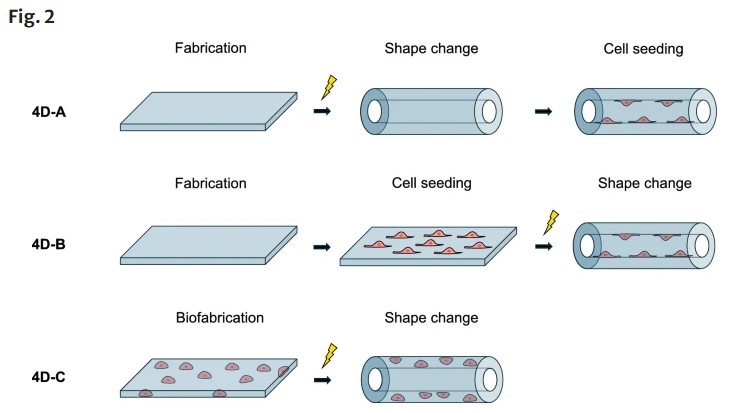
🟢 Overview: 4D Fabrication & Shape-Changing Scaffolds in Tissue Engineering
This 2024 review article explores how 4D fabrication—technologies enabling engineered structures to change shape or function over time in response to stimuli—is transforming tissue engineering (TE). Unlike traditional “static” scaffolds, 4D systems can adapt dynamically within living environments, holding huge promise for personalized, high-performance biomedical implants.
🧠 Why 4D Fabrication Matters
- Beyond Static: Classic 3D-printed scaffolds can’t react to changes in the body; 4D systems adapt—they can fold, self-assemble, or reshape in response to physical, chemical, or biological signals (like temperature, pH, light).
- Clinical Impact: Enables patient-specific implants that integrate better with tissues, improve healing, and enable functions (e.g., drug release, guided tissue growth) impossible with passive materials.
🔬 Materials & Methods
- Shape-Changing Soft Materials: Two main families:
- Shape-Memory Polymers (SMPs): Plastics that “remember” shapes and change form when triggered.
- Shape-Memory Hydrogels (SMHs): Water-rich gels responsive to stimuli.
- Fabrication Approaches:
- 4D-A: Shape change first, then cell seeding.
- 4D-B: Cell seeding, then activation of shape change.
- 4D-C: Direct (bio)fabrication of living shape-changing constructs.
- Manufacturing Techniques: Solvent casting, freeze-drying, gas foaming for classic scaffolds; additive manufacturing, direct ink writing, stereolithography for complex, custom 4D structures.
🧩 Characterization
- Physical Properties: Tunable by controlling material chemistry and fabrication method (e.g., porosity, mechanical strength, shape recovery behavior).
- Biological Evaluation:
- Cell Compatibility: Testing with relevant cell types.
- Dynamic Response: Assessment of scaffold shape change in relevant (in vitro or in vivo) conditions.
- Performance Benchmarks: Focused on how well scaffolds support cell growth, integrate into tissues, and respond to environmental cues.
🦾 Application & Outlook
- Scaffold Use: Dynamic tissue scaffolds, self-fitting implants, smart drug delivery systems, evolving cellular microenvironments.
- Challenges: Material selection (balancing bioactivity and mechanical needs), predictable stimulus-response, and scaling up biofabrication for real clinical use.
- Future Directions: Integrating predictive modeling, smarter triggers, and personalized medicine approaches for next-gen regenerative therapies.
💡 Why It Matters
4D fabrication has the potential to revolutionize how we repair, replace, or enhance human tissues—moving from static, “one-size-fits-all” solutions to responsive, living systems engineered for each patient and each clinical scenario.
📖 Source:
Bonetti L, Scalet G. 4D fabrication of shape-changing systems for tissue engineering: state of the art and perspectives. Published: August 2024 (Springer)
https://arxiv.org/abs/2501.07612

No comment